POLICIES
Defining what agentic systems are allowed to do
Define what your agents are allowed to do — and enforce it everywhere, instantly.
Waxell Policies are runtime enforcement rules for AI agents — defined once in the governance plane, applied uniformly across every workflow, and evaluated deterministically before execution proceeds. When a policy changes, it changes everywhere. No code deploy required.
Define what your agents are allowed to do — and enforce it everywhere, instantly.
Waxell Policies are runtime enforcement rules for AI agents — defined once in the governance plane, applied uniformly across every workflow, and evaluated deterministically before execution proceeds. When a policy changes, it changes everywhere. No code deploy required.
Free to start. 2-line setup.

SOC 2 compliant
Define what your agents are allowed to do — and enforce it everywhere, instantly.
Waxell Policies are runtime enforcement rules for AI agents — defined once in the governance plane, applied uniformly across every workflow, and evaluated deterministically before execution proceeds. When a policy changes, it changes everywhere. No code deploy required.
Free to start. 2-line setup.
SOC 2 compliant
Without explicit rules, acceptable agent behavior is implicit —
which means it's inconsistent.
One workflow allows an outbound email.
Another doesn't.
One session respects a cost ceiling.
Another runs until the bill arrives.
Governance that lives inside agent code can't be managed centrally and can't change without a deployment.
Without explicit rules, acceptable agent behavior is implicit —
which means it's inconsistent.
One workflow allows an outbound email.
Another doesn't.
One session respects a cost ceiling.
Another runs until the bill arrives.
Governance that lives inside agent code can't be managed centrally and can't change without a deployment.
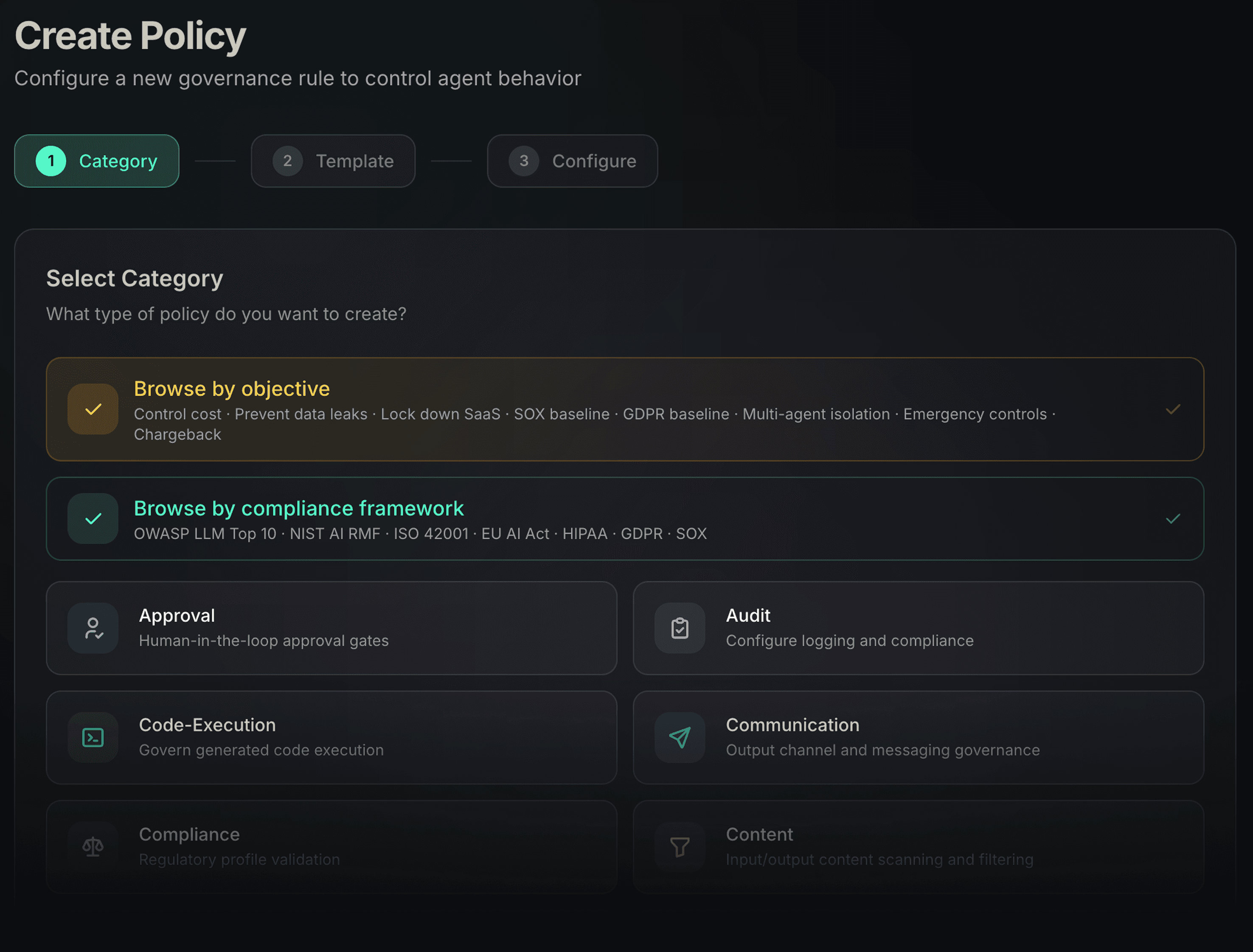
What Waxell Policies Do
Policies in Waxell are first-class governance objects — not config files, not embedded business logic, not assumptions documented somewhere in a Notion page.
They live in the governance plane and are applied by reference across every workflow that uses them. Agents don't carry local copies of policy logic. They don't interpret rules independently. The governance plane is the single source of truth.
Waxell ships with 50+ policy categories — from cost limits and kill switches to PII protection and human approval gates. You configure the rules. Waxell enforces them before the next step executes, not after the damage is done.
50+ Policy Categories.
Every One Enforced at Runtime.
50+ Policy Categories.
Every One Enforced at Runtime.
Every category below is evaluated before execution proceeds — not logged after the fact.
Audit & Compliance
Safety & Content
Cost & Budget
Access Control
Operations
Quality
Scheduling
Identity
Grounding & Custom
Three Differentiators
CHANGES TAKE EFFECT IMMEDIATELY
Policies aren't embedded in agent code — they live in the governance plane and are applied by reference. Adjust a rule and it propagates across every workflow that references it, instantly. No redeployment. No drift.
MANAGED BY NON-ENGINEERS
Policy ownership belongs to the people responsible for governance, compliance, and operations — not the engineers who wrote the workflows. Because policy logic is separate from agent code, adjusting a rule doesn't require touching the system it governs.
DETERMINISTIC BY DESIGN
When a policy condition isn't met, execution stops. No probabilistic reasoning, no adaptive override, no silent exception. The outcome is explicit and logged — which policy applied, what condition failed, and the surrounding context — before you ever need to look.
How It Works
01
Define your rules in the governance plane
Choose from 45+ policy categories or configure custom rules. Set thresholds, conditions, and enforcement behavior. Policies are objects, not code — created and managed in the Waxell interface.
02
Waxell applies them by reference across every workflow
Your agents don't carry policy logic. When a workflow runs, Waxell evaluates all applicable policies against current execution context. If conditions are met, execution proceeds. If not, it stops — cleanly, immediately, and with a full record of why.
03
Review, adjust, repeat — without touching your agents
When a rule needs to change, change it in the governance plane. It takes effect everywhere, immediately. Run a test to verify the new behavior before it reaches production. See [Testing] for how pre-production policy validation works.
Three Differentiators
CHANGES TAKE EFFECT IMMEDIATELY
Policies aren't embedded in agent code — they live in the governance plane and are applied by reference. Adjust a rule and it propagates across every workflow that references it, instantly. No redeployment. No drift.
MANAGED BY NON-ENGINEERS
Policy ownership belongs to the people responsible for governance, compliance, and operations — not the engineers who wrote the workflows. Because policy logic is separate from agent code, adjusting a rule doesn't require touching the system it governs.
DETERMINISTIC BY DESIGN
When a policy condition isn't met, execution stops. No probabilistic reasoning, no adaptive override, no silent exception. The outcome is explicit and logged — which policy applied, what condition failed, and the surrounding context — before you ever need to look.
How It Works
Set once.
Your tools do the rest.
01
Define your rules in the governance plane
Choose from 50+ policy categories or configure custom rules. Set thresholds, conditions, and enforcement behavior. Policies are objects, not code — created and managed in the Waxell interface.
02
Waxell applies them by reference across every workflow
Your agents don't carry policy logic. When a workflow runs, Waxell evaluates all applicable policies against current execution context. If conditions are met, execution proceeds. If not, it stops — cleanly, immediately, and with a full record of why.
03
Review, adjust, repeat — without touching your agents
When a rule needs to change, change it in the governance plane. It takes effect everywhere, immediately. Run a test to verify the new behavior before it reaches production. See [Testing] for how pre-production policy validation works.
Set once.
Your tools do the rest.
01
Define your rules in the governance plane
Choose from 45+ policy categories or configure custom rules. Set thresholds, conditions, and enforcement behavior. Policies are objects, not code — created and managed in the Waxell interface.
02
Waxell applies them by reference across every workflow
Your agents don't carry policy logic. When a workflow runs, Waxell evaluates all applicable policies against current execution context. If conditions are met, execution proceeds. If not, it stops — cleanly, immediately, and with a full record of why.
03
Review, adjust, repeat — without touching your agents
When a rule needs to change, change it in the governance plane. It takes effect everywhere, immediately. Run a test to verify the new behavior before it reaches production. See [Testing] for how pre-production policy validation works.
POLICY A
POLICY B
POLICY C
POLICY D
Designed to scale
Centralized, reference-based policies scale cleanly across workflows, teams, and environments.
They are suitable for systems where execution is continuous, changes are expected, and governance must remain consistent over time.
Policies do not become harder to manage as automation expands. They become more important.
CallSine automatically finds and researches each prospect by analyzing their website, LinkedIn profile, and company information. Get comprehensive insights instantly without spending hours on manual research. It even works with your existing database.
From here
Waxell is available now.
Install the SDK, connect to your instance, and start capturing what your agents actually do. Governance, policy enforcement, cost tracking, and full telemetry — running from the moment you initialize.
Free during beta. 2-line setup.
FAQ
What is AI agent policy enforcement?
AI agent policy enforcement is the practice of applying predefined governance rules to autonomous agents at runtime — before or during execution — to ensure they operate within defined boundaries. Unlike observability, which records what agents did, enforcement prevents disallowed actions from completing. Waxell enforces policies deterministically across 26 categories, including cost limits, content filtering, kill switches, and PII protection.
How does Waxell enforce policies before execution begins?
When a workflow is triggered, Waxell evaluates all applicable policies against the current context before execution proceeds. Policies are stored centrally in the governance plane — not embedded in agent code — and applied by reference. If a policy condition is not met, execution stops and the outcome is logged with full context. There is no probabilistic reasoning, adaptive override, or silent exception.
What types of AI agent policies can Waxell enforce?
Waxell supports 26 policy categories covering the full surface area of agent behavior: cost and token limits, content and input scanning, PII protection, kill switches, rate limits, scheduling constraints, identity controls, data access restrictions, LLM-specific rules, human approval gates, and more. For teams with compliance requirements, Waxell Assurance covers how these policies map to audit, accountability, and operational trust.
Can Waxell policies be applied to existing agents without code changes?
Yes. Waxell instruments existing Python agents in two lines of code — install the SDK, initialize before your imports, and policy enforcement begins automatically. Waxell is framework-agnostic and works with LangChain, CrewAI, LlamaIndex, and custom Python agents. No changes to existing agent logic are required.
What happens when a Waxell policy blocks an agent execution?
When a policy condition is not met, execution halts and the event is recorded with full context — which policy applied, what condition failed, and the surrounding execution state. The record exists immediately and is inspectable without reconstructing from logs. Policy owners can review blocked executions, adjust rules, and retest using the same inputs and constraints that triggered the block.
From here
Waxell is available now.
Install the SDK, connect to your instance, and start capturing what your agents actually do. Governance, policy enforcement, cost tracking, and full telemetry — running from the moment you initialize.
Free during beta. 2-line setup.

FAQ
What is AI agent policy enforcement?
AI agent policy enforcement is the practice of applying predefined governance rules to autonomous agents at runtime — before or during execution — to ensure they operate within defined boundaries. Unlike observability, which records what agents did, enforcement prevents disallowed actions from completing. Waxell enforces policies deterministically across 50+ categories, including cost limits, content filtering, kill switches, and PII protection.
How does Waxell enforce policies before execution begins?
When a workflow is triggered, Waxell evaluates all applicable policies against the current context before execution proceeds. Policies are stored centrally in the governance plane — not embedded in agent code — and applied by reference. If a policy condition is not met, execution stops and the outcome is logged with full context. There is no probabilistic reasoning, adaptive override, or silent exception.
What types of AI agent policies can Waxell enforce?
Waxell supports 50+ policy categories covering the full surface area of agent behavior: cost and token limits, content and input scanning, PII protection, kill switches, rate limits, scheduling constraints, identity controls, data access restrictions, LLM-specific rules, human approval gates, and more. For teams with compliance requirements, Waxell Assurance covers how these policies map to audit, accountability, and operational trust.
Can Waxell policies be applied to existing agents without code changes?
Yes. Waxell instruments existing Python agents in two lines of code — install the SDK, initialize before your imports, and policy enforcement begins automatically. Waxell is framework-agnostic and works with LangChain, CrewAI, LlamaIndex, and custom Python agents. No changes to existing agent logic are required.
What happens when a Waxell policy blocks an agent execution?
When a policy condition is not met, execution halts and the event is recorded with full context — which policy applied, what condition failed, and the surrounding execution state. The record exists immediately and is inspectable without reconstructing from logs. Policy owners can review blocked executions, adjust rules, and retest using the same inputs and constraints that triggered the block.

Waxell
Waxell provides observability and governance for AI agents in production. Bring your own framework.
Compliance: NIST AI RMF · EU AI Act · SOC 2 compliant · ISO/IEC 27001:2022 certified · HIPAA (in progress)
Governed continuously in Vanta.

© 2026 Waxell. All rights reserved.
Patent Pending.
Waxell
Waxell provides observability and governance for AI agents in production. Bring your own framework.
Compliance: NIST AI RMF · EU AI Act · SOC 2 compliant · ISO/IEC 27001:2022 certified · HIPAA (in progress)
Governed continuously in Vanta.
© 2026 Waxell. All rights reserved.
Patent Pending.
Waxell
Waxell provides observability and governance for AI agents in production. Bring your own framework.
Compliance: NIST AI RMF · EU AI Act · SOC 2 compliant · ISO/IEC 27001:2022 certified · HIPAA (in progress)
Governed continuously in Vanta.
© 2026 Waxell. All rights reserved.
Patent Pending.