
SIGNAL & DOMAIN
Give agents real context
without giving them your database.
Waxell Signal and Domain is a governed data boundary for autonomous agent systems. Signal defines how external systems send information in; Domain defines how agents act back out — and every input and action is logged and policy-enforced. Agents get the context they need to be useful. Production systems stay untouched.
THE PROBLEM
Most architectures force a trade-off. Agents either run isolated with incomplete context, or get direct access to production systems — which means exposing internal databases and scattering execution data across systems the platform can't observe. One makes agents useless; the other makes them unsafe. Neither is governable.

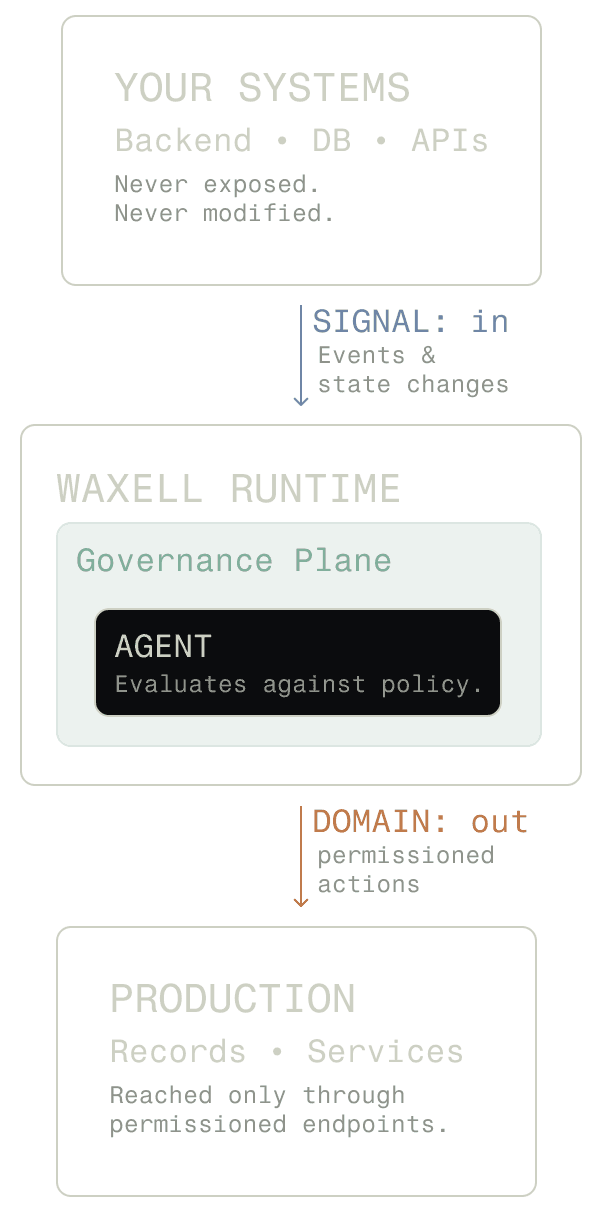
Signal and Domain are the third option: a narrow, governed communication surface instead of broad, implicit access. Here's one run, end to end:
A billing event fires in your backend. It sends a Signal to Waxell — a payload describing the change. The agent receives it, evaluates it against current policies, and calls a Domain endpoint to update the customer record. Every step — the Signal input, the agent's decision, the Domain call, what was allowed, what completed — is in the execution record before the next event arrives. The billing system and the database were never exposed to the agent. Neither required modification.
SIGNAL — DATA IN
External systems notify agents about events, state changes, or new data without granting database access. Every Signal invocation is logged as part of the agent's execution context.
DOMAIN — ACTIONS OUT
Agents act only through Domain endpoints — discrete, permissioned capabilities like "send an email" or "update a record." Each call enforces authentication, authorization, and policy, and is logged automatically.
A GOVERNED BOUNDARY
Agents never touch production databases. External systems never run inside the Waxell runtime. Policies and kill-switches apply at the Domain level — data access and actions become first-class governance surfaces, not hidden side effects.
Adopt it incrementally
No infrastructure overhaul. Connect one system to Signal, define one Domain endpoint — no migration, no weakening of existing security controls. The communication boundary is defined at the Waxell level, so production stays intact while you add agent capabilities one surface at a time.

POLICY A
POLICY B
POLICY C
POLICY D
Designed to scale